
Vrbo’s New 12% Commission: What It Really Costs (and What We’re Doing About It)
By Chris Miller, Owner, Stay Coastal Hospitality (Florida vacation rental management, Daytona Beach) · Last updated: November 2, 2026
Key takeaways (TL;DR)
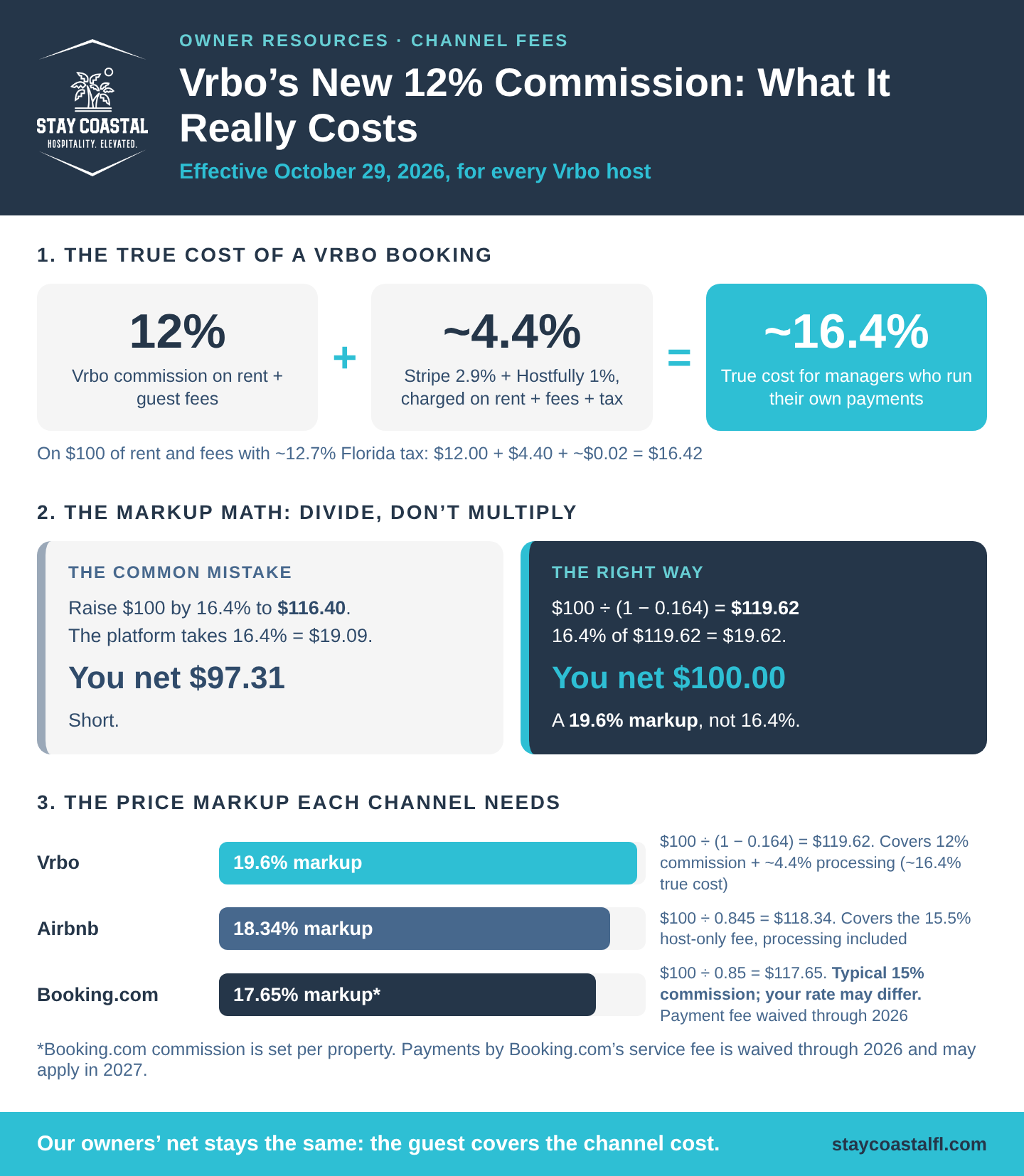
Vrbo’s 12% commission, in effect since October 29, 2026, really costs a Florida property manager who runs their own payments about 16.4% per booking once card processing is added. To net the same as before, a Vrbo rate needs a 19.6% markup, compared with an 18.34% markup on Airbnb’s 15.5% host-only fee.
The 12% applies to rent plus guest fees such as cleaning and pet fees, not to taxes or refundable deposits.
Card processing (Stripe 2.9% + Hostfully 1%) is charged on the full amount including tax, which adds about 4.4%.
Divide, don’t multiply: $100 ÷ (1 − 0.164) = $119.62, a 19.6% markup.
Booking.com typically charges about 15% commission, and its Payments by Booking.com service fee is waived through 2026, so at that typical rate it needs a 17.65% markup ($100 ÷ 0.85 = $117.65). Your rate may differ.
Stay Coastal owners’ net does not change, because each channel’s markup covers its own fees.
On October 29, 2026, Vrbo moved every host to a flat 12% commission (Expedia Group’s announcement). For property managers like us who were paying 5%, that is more than double, and once you add payment processing the real cost of a Vrbo booking lands around 16%. Here is the math, why Vrbo is doing it, how it stacks up against Airbnb and Booking.com, and how we are handling it so our owners’ net stays exactly where it was.
If you own a vacation rental on Florida’s east coast, in Volusia, Flagler or St. Johns County (Daytona Beach, New Smyrna Beach, Flagler Beach, Palm Coast or St. Augustine), and you list on Vrbo, this change affects what lands in your account from every Vrbo booking made since October 29.

What did Vrbo change on October 29, 2026?
Vrbo’s 12% commission is a flat host fee on every booking made on or after October 29, 2026, charged on the rental amount plus the guest fees you charge.
Until October 29, Vrbo charged hosts in two main ways. If you listed on your own, you paid 5% commission plus 3% payment processing, about 8% all in. If you ran your listings through property management software (we use Hostfully), you paid 5% and handled your own processing.
As of October 29, 2026, that became one number: 12% on every booking made from that date forward. Vrbo calculates it on the rental amount plus the guest fees you charge, so cleaning fees, pet fees and the like are all commissionable. Taxes and refundable deposits are not (Vrbo’s pay-per-booking help article).
The traveler service fee that guests pay on top of your price did not go away. The 12% is charged to the host in addition to it (OwnerRez’s summary of the Vrbo change).
Hostfully put it simply in their October 13 note to customers: on a $100 nightly rate you kept about $95 before the change and about $88 after October 29. Their advice was to review your Channel Rate Multiplier for Vrbo before the switch, which is exactly what the rest of this post works through.
Why is Vrbo raising its commission to 12%?
Vrbo’s own explanation is that one simple rate helps “travelers find the most competitive rates” and keeps Vrbo “competitive” against other platforms (Rental Scale-Up’s report on Vrbo’s host email). Read between the lines and it is two things.
First, Vrbo (owned by Expedia Group) was charging far less than Airbnb and Booking.com, and leaving money on the table. Airbnb moved to a host-only fee of 15.5% for software-connected hosts; Booking.com has charged around 15% for years. Vrbo at 5% was the cheap channel, and Expedia decided it did not need to be.
Second, it simplifies the business. Multiple fee structures and separate processing fees are a lot to maintain. One flat rate that includes processing for hosts who use Vrbo’s own payment system is easier to sell and easier to run.
The practical upshot for hosts is that the three big platforms now all take somewhere between 12% and 16% of every booking. The era of Vrbo being the bargain channel is over.
Photo: Raymond Kotewicz on Unsplash
How much does a Vrbo booking really cost a property manager?
The true cost of a Vrbo booking is the 12% commission plus your own card processing, which comes to about 16.4% for a Florida manager running payments through Stripe and Hostfully.
The 12% headline is not the whole bill. Vrbo says the 12% “includes payment processing,” but that only applies if Vrbo is your merchant of record. If you collect payment yourself through your property management software, as most professional managers do, you still pay your own processor on top of the 12% (Vrbo help: pay-per-booking fees).
In our case that is Stripe at 2.9% + $0.30 per transaction, plus Hostfully’s 1% platform fee on every card payment, so 3.9% plus thirty cents. And here is the part that catches people: processing is charged on the full amount the guest’s card is hit for, which includes the taxes we collect and pass through. Vrbo’s 12% is not charged on tax, but Stripe’s 3.9% is.
On $100 of rent and fees, with Florida taxes running about 12.7% on top:
| Charge | Applies to | Cost |
|---|---|---|
| Vrbo commission, 12% | Rent + guest fees ($100) | $12.00 |
| Stripe 2.9% + Hostfully 1% | Rent + fees + tax ($112.69) | $4.40 |
| Stripe $0.30 flat | Per booking, spread over a ~$1,700 average stay | ~$0.02 |
| Total cost on $100 | $16.42 |
So the true cost of a Vrbo booking for a manager running their own payments is about 16.4%, not 12%. That is the number to plan around.
Why does a 12% commission need a 19.6% markup?

A channel markup is the percentage you add to your base nightly rate on one booking channel so that, after that channel’s fees, you net the same as a direct booking.
If a platform takes 16.4% of what the guest pays, you cannot just raise your price by 16.4% and call it even. Here is why. Say you want to net $100. Raise the price to $116.40 and the platform takes 16.4% of $116.40, which is $19.09. You net $97.31. Short.
The fee is charged on the marked-up price, not the original, so you have to divide, not multiply. To net $100 after a 16.4% cut:
$100 ÷ (1 − 0.164) = $119.62
That is a 19.6% markup over your true net. Check it: 16.4% of $119.62 is $19.62, leaving exactly $100.
Photo: Jakub Żerdzicki on Unsplash
We did the same exercise on Airbnb when they moved to a 15.5% host-only fee (our breakdown of Airbnb’s 15.5% host fee). Everyone assumed you mark up 15.5%. The real number is $100 ÷ 0.845 = $118.34, so an 18.34% markup, and that is what we run on our Airbnb channel today.
For Vrbo, that 19.6% breaks into two pieces. We already carry about a 4% markup on all channels to cover card processing. The Vrbo-specific piece on top of that is 1.196 ÷ 1.04, which is about 15%. So our Vrbo channel markup moved from 9% to roughly 15%, on top of the 4% processing layer that was already there.
Vrbo vs Airbnb vs Booking.com: which channel costs more?
The fair comparison is the total the platform plus your processor take out of each booking, because the three handle payments differently, and then the markup each one needs so you net the same.
Photo: Ace King on Unsplash
| Platform | Host fee | Who processes the card | Processing cost to host | True cost per booking | Markup needed to net the same | Guest also pays |
|---|---|---|---|---|---|---|
| Airbnb (host-only fee) | 15.5% on rent + fees | Airbnb | Included | ~15.5% | 18.34% ($100 ÷ 0.845 = $118.34) | Nothing extra |
| Vrbo (since Oct 29, 2026) | 12% on rent + fees | You (Stripe via Hostfully) | ~4.4% incl. tax portion | ~16.4% | 19.6% ($100 ÷ (1 − 0.164) = $119.62) | Vrbo traveler service fee |
| Booking.com (Payments by Booking.com) | ~15% on room rate + fees you charge, not on local taxes (typical US rate; set per property) | Booking.com | Payments Service Fee waived through 2026 (may apply in 2027) | ~15% (typical) | 17.65% at a typical 15% commission ($100 ÷ 0.85 = $117.65); your rate may differ | Nothing extra |
A few notes on reading that table. Airbnb’s 15.5% covers everything, and the guest pays no service fee on top, so your listed price is what the guest sees. Booking.com’s commission is set per property and usually lands around 15% in the US (Wise’s Booking.com fees guide for US hosts), so your own rate may differ. It is charged on the room rate plus fees you charge, such as cleaning, but Booking.com does not charge commission on local taxes such as city tax. Payments by Booking.com normally adds a payment service fee, but Booking.com announced in November 2025 that this fee is waived through 2026 for Payments by Booking.com facilitated by Stripe, and that fees may apply in 2027. At a typical 15% commission with no payment fee, that works out to a 17.65% markup ($100 ÷ 0.85 = $117.65). Vrbo is the only one of the three where you still run your own processing, and where the guest pays a separate service fee on top of your price.
So is Vrbo now more expensive than Airbnb? For a manager on their own payments, yes, by about a point, and that is before the guest’s service fee, which makes the same listing look pricier on Vrbo than on Airbnb. That is why the Vrbo markup (19.6%) is now higher than the Airbnb markup (18.34%). Is it more expensive than Booking.com? At a typical 15% Booking.com commission with the payment fee waived through 2026, yes: Booking.com needs about a 17.65% markup, so Vrbo now needs the highest markup of the three. Vrbo went from clearly the cheapest channel to the most expensive one to offset.
What does Vrbo’s 12% commission mean for Stay Coastal owners?

Short version: nothing changes in your net. The Vrbo fee is a channel cost that the guest pays, not you.
Here is how it works. Every channel we list on gets its own markup over the base rate, sized to that channel’s fees. Airbnb is marked up 18.34%. At a typical 15% commission, with its payment fee waived through 2026, Booking.com needs about 17.65%. Vrbo was marked up 9%; on October 29 it moved to roughly 15% on top of the processing layer, for a total of about 19.6%. When a guest books through Vrbo, they pay the marked-up price, Vrbo takes its 12%, Stripe takes its processing, and what lands in the account is the same base rate a direct booking would have produced. You never see a Vrbo commission line on your owner report because the guest already covered it.
One thing worth knowing: this makes our listings look more expensive on Vrbo than on Airbnb or our direct site, and Vrbo adds its own traveler fee on top of that. Some Vrbo guests will notice and book elsewhere, which is fine, because the same dates on Airbnb or direct net you the same or more. The cheapest place for a guest to book any of our homes is, and will stay, our own website.
A Stay Coastal managed home
If you have questions about how this affects your property specifically, reach out to our team and we will walk through your numbers. You can also see how our Florida vacation rental management works, or read the real cost of self-managing your Airbnb. We manage homes in areas including Daytona Beach, Flagler Beach and St. Augustine.
Frequently Asked Questions (FAQs)
1. What did Vrbo change on October 29, 2026?
Vrbo moved every host to a flat 12% commission on every booking made from October 29, 2026 forward. Before that, hosts paid 5% commission, plus 3% payment processing if they listed on their own.
2. What does the 12% apply to?
It is calculated on the rental amount plus the guest fees you charge, such as cleaning and pet fees. Taxes and refundable deposits are not commissionable. The traveler service fee guests pay is charged in addition to it.
3. What is the true cost of a Vrbo booking?
For a manager who runs their own payments, about 16.4%: the 12% commission plus about 4.4% in card processing (Stripe 2.9% plus Hostfully’s 1%, charged on the full amount including tax), plus a few cents for Stripe’s $0.30 fee.
4. Why is the markup 19.6% and not 16.4%?
Because the fee is charged on the marked-up price, you divide instead of multiply: $100 ÷ (1 − 0.164) = $119.62. A 16.4% markup to $116.40 would only net $97.31.
5. What markup does Airbnb’s 15.5% host-only fee need?
An 18.34% markup: $100 ÷ 0.845 = $118.34. Raising the price by only 15.5% would leave you short, for the same reason as on Vrbo.
6. Is Vrbo now more expensive than Airbnb for hosts?
For a manager on their own payments, yes, by about a point: roughly 16.4% true cost on Vrbo versus 15.5% on Airbnb, which is why Vrbo needs a 19.6% markup versus 18.34% on Airbnb. Vrbo guests also pay a separate traveler service fee.
7. What markup does Booking.com need?
At a typical 15% commission, a 17.65% markup: $100 ÷ 0.85 = $117.65. Booking.com sets commission per property, so your rate may differ. It does not charge commission on local taxes such as city tax, and its Payments by Booking.com service fee is waived through 2026 and may apply in 2027.
8. Does the Vrbo change reduce what Stay Coastal owners earn?
No. Each channel gets its own markup sized to its fees, so the guest covers the Vrbo commission and processing, and what lands in the account is the same base rate a direct booking would have produced.
Is Vrbo’s 12% commission quietly costing your property money?
If your Vrbo rates haven’t changed since October 29, your net per booking may have dropped. Book a free channel-pricing review with Chris. We’ll look at your Vrbo, Airbnb and Booking.com markups together and show you what each booking actually nets.
Book a free pricing reviewContact Stay CoastalSources
Hostfully, “Vrbo’s fee update starts October 29: What you need to know,” email to Hostfully customers, October 13, 2026
OwnerRez: Vrbo is changing its commission fee to 12%: What you need to know
Rental Scale-Up: Vrbo moves all hosts to a single 12% commission
Skift: Vrbo to double commissions as it plays catch-up to Airbnb
Booking.com for Partners: How much Payments by Booking.com costs
Booking.com, “No Payments Service Fee through 2026 with Payments by Booking.com facilitated by Stripe,” email to partners, November 2025
About the author: Chris Miller is the owner of Stay Coastal Hospitality, a full-service Florida vacation rental management company based at 2665 N Atlantic Ave, Daytona Beach, FL. This post reflects the channel markups we use on the homes we manage.
